
Looking for High Purity 2-Chloro-2,6-dimethylacetanilide Supplier in India?
Not every chemical in a pharma supply chain gets a spotlight — some just quietly make the next step possible. That's exactly the role this compound plays. It's not the finished drug, not even close, but without it, getting to lidocaine in the first place would look very different.
Known in analytical and pharmacopeial literature as Lidocaine Related Compound H, 2-Chloro-2,6-dimethylacetanilide (CAS 1131-01-7) is an indispensable synthetic building block. Its precise molecular configuration guarantees the correct aromatic core required for producing high-purity Lidocaine API, making impurity control at this stage vital for overall batch compliance.
We synthesize this key intermediate under strict quality control standards at our Ankleshwar plant. Sourcing well-characterized intermediate material allows API manufacturers and CDMOs to minimize reaction side-products, streamline purification steps, and maintain consistent quality across large-scale production batches.
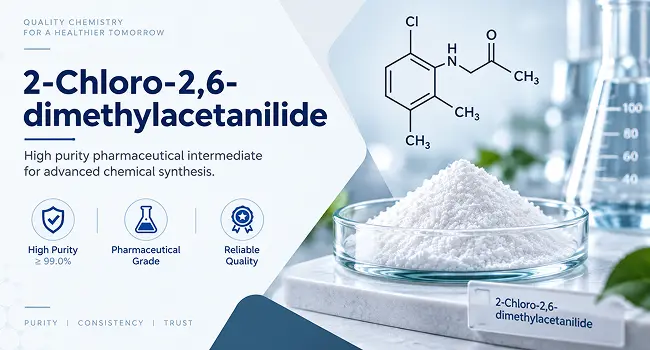
General Information
This compound is also known as N-Chloroacetyl-2,6-dimethylaniline in addition to several other names. It occurs in the form of white to light yellow or orange colored crystals and its melting point is reported to be between 146-150°C. It is soluble in chloroform and methanol but not in water. The importance of these physical properties will become clear during its future use in the course of synthesis reactions.
It is important to note that its main significance in drug manufacturing industry lies in being an intermediate in the manufacture of lidocaine. This compound acts as an intermediate compound in lidocaine synthesis pathway. That's why it is also referred to as "Lidocaine Related Compound H". For anyone manufacturing lidocaine at scale, having a reliable, well-characterized source of this intermediate isn't a nice-to-have — it's foundational to the whole process running smoothly.
Beyond its synthetic role, it also shows up in analytical chemistry — specifically in methods used to determine enantiomers of tocainide in blood plasma through gas-liquid chromatography with electron-capture detection. That's a fairly specialized application, but it speaks to the compound's broader relevance across pharmaceutical research and quality testing, not just manufacturing.
Handling-wise, it carries an eye irritation hazard classification (Category 2, H319), so standard laboratory protective measures — gloves, eye protection — apply during use.
Applications
Key application areas for 2-Chloro-2,6-dimethylacetanilide:
Synthesis intermediate for Lidocaine API
The major use of this chemical substance is as an intermediate in the production of lidocaine API where it plays a major role in the synthesis route.
Analytical chromatography reference
This compound can also be employed in analytical chemistry as one of the substances that can be analyzed using different chromatography techniques.
Standard of comparison in intermediate studies
Apart from serving as a key intermediate in lidocaine API manufacture, its physical properties make it a standard of comparison in pharmaceutical intermediate studies due to high consistency and reproducibility of these properties.
Lidocaine Related Compound H reference
It is used as a reference substance in pharmacopeia under names such as "Lidocaine Related Compound H" and it is used in identification and impurity profiling studies of lidocaine API.
Process monitoring reference
In process chemistry, its specific melting point and solubility make it a good reference substance in process monitoring.
