
Looking for High Purity Chloroform Supplier in India?
Say "chloroform" and most people picture something out of an old detective novel. Understandable, honestly — that's where its reputation comes from. But walk into an actual pharmaceutical lab today, and it's doing something far less cinematic: quietly pulling compounds apart as an extraction solvent. That's really its job now. Nothing more, nothing dramatic.
We supply Pharma Grade Chloroform (CAS 67-66-3) from Ankleshwar, Gujarat — manufactured to meet the purity standards required for pharmaceutical extraction work, analytical applications, and reagent-grade laboratory use. Its high solvency for fats, resins, and alkaloids makes it effective in liquid-liquid extraction steps where other solvents fall short. Proper handling protocols, storage guidance, and full safety documentation are part of what we provide along with supply.
If you're evaluating a chloroform supplier for a regulated application — or switching from a current source — we can share CoA data, MSDS, and availability details. Domestic and export supply; responses within one business day.
General Information
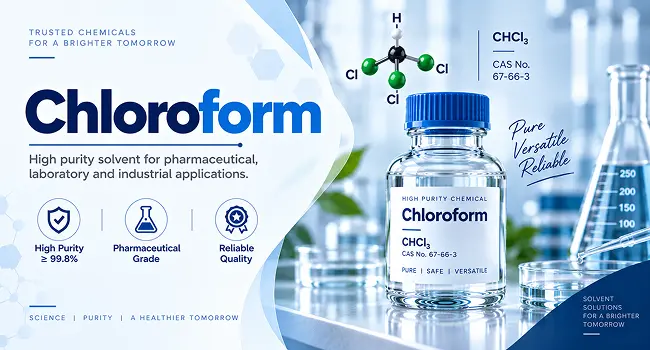
Chloroform, CAS No. 67-66-3, goes by trichloromethane if you want to get technical about it. CHCl₃ on paper. In real life it's a clear, colorless liquid, dense, with a strong smell — sweetish, almost sharp. Doesn't sound like much until you realize how good it is at dissolving things. Chloroform can extract all these components from the substance with ease, which is one of the main reasons why it has been favored in labs over the past century.
And one important misconception that needs clarification is that yes, indeed, chloroform was used as an anesthetic. It certainly was. But that use was dropped a long time ago — turned out to be too rough on the liver and kidneys for anyone to keep using it that way. So forget the old associations. What we're talking about here is a reagent, a process solvent. Not something anyone's administering to a patient.
Where it actually shines is extraction work. Something needs pulling out of a plant material, or a messy reaction mixture needs cleaning up? Chloroform tends to get the job done. It also turns up as a reagent in producing certain industrial chemicals, and analytical labs lean on it too — as a reference solvent for spectrophotometric and spectrofluorimetric work.
One caveat, and it's not a small one: this stuff needs respect. It's classified as hazardous. Ventilation, protective gear, proper storage — none of that is optional.
Applications
Chloroform serves critical extraction, synthetic, and quality control functions:
Plant and biological extraction
Extraction is probably where chloroform earns its keep most. Pulling alkaloids, fats, oils, waxes, and resins out of plant or biological material — that's bread-and-butter work for this solvent, thanks to how well it dissolves organic compounds in general.
Synthetic chemical reagent
It's also a reagent in its own right, showing up across various synthesis processes in both pharma and broader industrial chemistry.
Spectrophotometric analysis
Then there's the analytical side. Labs use it as a reference standard in spectrophotometric and spectrofluorimetric analysis, helping determine analyte concentrations in bulk drugs and dosage forms.
Quality control testing
And beyond that — quality control testing generally, where it supports pharma release testing and method development work.
