
Looking for a Reliable Lidocaine API Manufacturer in India?
Sourcing pharmaceutical-grade anesthetic APIs isn't something you want to get wrong. One inconsistent batch, and a formulation timeline can slip by months. That's really where we fit in — we're a Lidocaine API manufacturer based in Ankleshwar, Gujarat, sitting right inside India's largest chemical industrial belt. Lidocaine has been part of our production line for years now, alongside a wider portfolio of pharmaceutical bulk drugs and intermediates.
We're not a facility that dabbles in lidocaine as an afterthought. Every batch goes through the same quality discipline as the rest of our API range, so formulators, CDMOs, and pharma companies worldwide don't have to second-guess what's arriving at their dock.
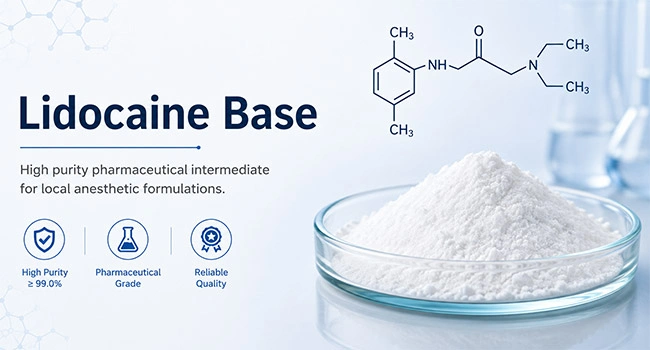
What Is Lidocaine Base and Where Is It Used?
Lidocaine Base is a free base local anesthetic and antiarrhythmic drug, and it's one of the more established actives in the pain-management and cardiac-care space. It's used to prevent and treat pain during surgical or diagnostic procedures — the kind of routine but necessary numbing that makes minor procedures tolerable for patients and predictable for clinicians. Beyond that, it also has a role in treating cardiac arrhythmias, which is part of what makes it a dual-purpose API rather than a single-use compound.
What tends to stand out about Lidocaine Base is its flexibility in administration. It can be given orally, applied topically, or delivered as a solution for injection — so the same base compound ends up supporting a fairly wide spread of downstream formulations, from creams to injectable solutions. For formulators, that flexibility matters: it means one well-characterized API can serve multiple product lines rather than needing a different active for every delivery format.
Mechanism of Action
Mechanistically, Lidocaine Base works by inhibiting ion flux across membranes — particularly sodium transport across the cell membrane. This decreases the depolarization phase of the action potential and blocks nerve action potential, which is the underlying reason it produces that fast, localized numbing sensation clinicians and patients rely on. It's a mechanism that's been well understood for decades, which is part of why lidocaine remains a default choice in so many anesthetic formulations rather than something newer trying to displace it.
Applications
Lidocaine Base finds its way into a handful of distinct product categories, largely because of how adaptable the base compound is:
Pain prevention and management during procedures
Used to prevent and treat pain during surgical or diagnostic procedures, where a reliable, fast-acting local anesthetic is non-negotiable.
Cardiac arrhythmia treatment
Its antiarrhythmic properties give it a role in formulations targeting irregular heart rhythms, which is a less commonly discussed but clinically important use case.
Topical relief formulations
Used further in formulations mainly applied topically to relieve itching, burning, and pain associated with inflamed skin. This is where a lot of consumer-facing and semi-clinical products — creams, gels, ointments — draw on lidocaine base as their active ingredient.
Because it supports oral, topical, and injectable routes, formulators sourcing Lidocaine Base aren't boxed into a single product category. Whether the end goal is a hospital-grade injectable or a topical anesthetic cream, the same core API can be the starting point.
