Looking for High Purity Polyethylene Glycol (PEG) Supplier in India?
PEG is one of those materials that shape-shifts depending on what you need — a runny liquid at low molecular weight, a waxy solid at high molecular weight, and somehow useful in both forms across a huge range of pharmaceutical work. Not many excipients pull off that kind of range.
Polyethylene Glycols represent a versatile polyether family whose physical state transitions smoothly from clear liquids (like PEG 200 and PEG 400) to firm waxy solids (such as PEG 4000 and PEG 8000). This molecular weight flexibility enables formulators to fine-tune viscosity, binding capacity, and dissolution rates across oral, topical, and parenteral dosage forms.
In addition to its conventional role as a binder, lubricant, and co-solvent, high-purity PEG is widely utilized in advanced biopharmaceutical applications like PEGylation to extend drug half-life. We supply USP/NF compliant Pharma Grade Polyethylene Glycol with stringent controls on ethylene oxide and dioxane impurities to ensure complete safety and performance.
General Information
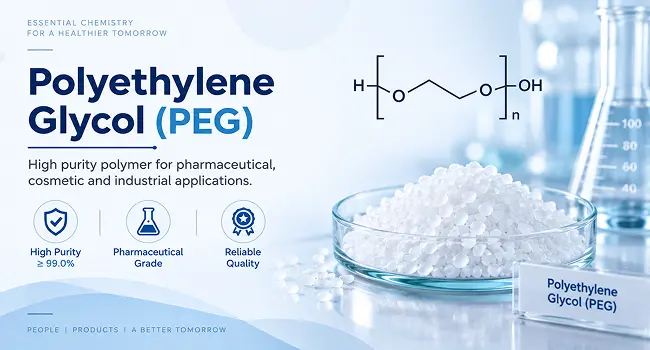
PEG, an abbreviation for Polyethylene Glycol, is a polyether which is made up of repeated units of ethylene glycol, which in terms of chemistry could be expressed as H−(O−CH₂−CH₂)ₙ−OH. The unique characteristic of this chemical lies in the variation in the physical state according to molecular weight. Low molecular weight forms such as PEG 200 and PEG 400 exist in liquid form. However, move onto high molecular weights such as PEG 4000 and PEG 8000 and they will be present as white flakes/powder.
That flexibility is really the whole point. Low molecular weight PEGs work as solvents, humectants, and plasticizers — you'll find them in liquid formulations, soft gelatin capsules, and topical products. Higher molecular weight versions shift roles entirely, acting as tablet binders or size-controlling agents in solid dosage forms. Few excipients can claim that kind of range across a single family of compounds.
PEG has been used in pharmaceutical applications for well over 50 years now, and its safety profile is well established — it's non-toxic, non-immunogenic, and FDA-recognized as safe across food, cosmetic, and pharmaceutical uses. One of its more specialized roles worth mentioning is PEGylation — attaching PEG chains to drug molecules to improve solubility, extend circulation time in the body, and reduce immunogenicity. That's become a genuinely important technique in modern drug delivery, not just a footnote.
Pharma-grade PEG is manufactured to USP/NF standards, with tight controls on impurities, residue, and optical absorbance — a different tier entirely from technical-grade PEG used in industrial or cosmetic applications.
Applications
Polyethylene Glycol (PEG) performs crucial solubilization, binding, and delivery roles:
Solubilization for poorly water-soluble APIs
Solubilization is probably PEG's most valuable pharma role — helping poorly water-soluble active ingredients dissolve properly, which directly affects how well a drug performs once administered.
Humectant, plasticizer & solvent vehicle
It also works as a humectant and plasticizer in liquid and semisolid formulations, and functions as a solvent vehicle across oral and topical drug products.
Tablet binder & solid dosage agent
Higher molecular weight grades serve as tablet binders and size-controlling agents in solid dosage forms.
PEGylation in modern drug delivery
And in more advanced applications, PEG plays a central role in PEGylation — improving the pharmacokinetics of drug molecules for better solubility and extended activity in the body.
